About this Edition
There is no irony in the artwork of Harry Morris. However sophisticated it may be in technique and depth of purpose, there is in it an absence of urbanity — that hallmark of the worldly. Immersing himself in the project at hand, Harry Morris does not stand on the sidelines paring his nails and chuckling faintly at something that, in its essence, does not take itself seriously. Irony, usually unwitting, has been ruinous for superlative art that, for whatever reason, has fallen under the generic head of horror.
In the late 1970s, Harry did a series of works collectively titled Halloween in Arkham. But his Halloween was not that of the child who is being tricked into participating in a ritual whose lamentably ironic message is that death and horror can be fun. Nor was it a version of Arkham as a Lovecraftian theme park where monsters pop up every second or so rather than whispering of the death and horror that the human race must deal with on a daily basis. Like the phony dance of death and celebration of horror enacted annually on the last day of October, the skulls and tentacles depicted on the cover of many an anthology of supernatural tales more often give us a childish thrill, a sense of mortality and existential chaos with tickles. For some strange and rare reason, however, Harry Morris seems incapable of trading in this kind of funhouse fare, this prophylactic irony. Not that he is self-righteously serious, the artistic counterpart of a churchman pounding the Bible and preaching a hell-fire sermon. It is just that he is in there, in the place of dreadful dreams, and he is sending out to us what he sees. And nothing in these dreams is ironic, nothing is ever revealed to be just a joke on the dreamer. But none of this is to say that the visions of Harry Morris’s art are not agreeably captivating and mysteriously hypnotic as gateways for those who like their dread served up in its purest possible form.
Pure dread possesses a geography, a home deep in some interior landscape where we watch ourselves rave in scenes of contorted glory, where we watch ourselves sleep in the paradoxical peace of perdition, and where we watch ourselves watching ourselves with the infinite eyes of dread.
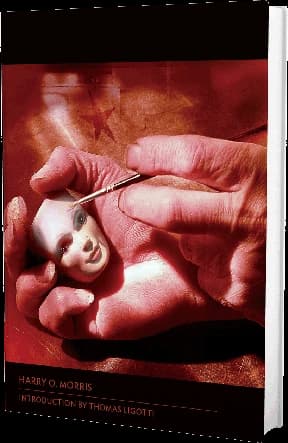
This collection of over 300 images contains a preface by Richard Matheson, an introduction by Thomas Ligotti, and an autobiography of Morris replete with period photographs.
Publication Details
Format
hardcoverEdition
LimitedPublished
2015-03
Ships
2015-03-31
ISBN
9781613470015
Print Run
300 copies
Retailer
Centipede PressProducer
Centipede PressPhysical Features
Contributors
Comments
…