
About this Edition
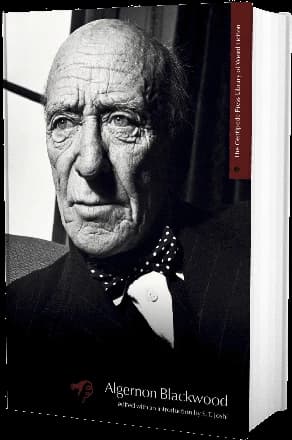
Algernon Blackwood: reporter, businessman, outdoorsman, violin teacher. Member of the Ghost Club and the Hermetic Order of the Golden Dawn. And author of dreams as darkly potent as anything in English fiction.
“The Willows,” Blackwood’s unsettling 1907 novella, tells of an unnamed narrator and his friend, who he calls “The Swede,” and the willow-crowded island they find themselves landing on. There, the narrator finds himself wondering what would happen if “these crouching willows proved to be alive; if suddenly they should rise up, like a swarm of living creatures, marshaled by the gods whose territory we had invaded…” An awful night passes. The atmosphere presses down on them; strange noises sound; strange shadows appear; and the willows seem to have moved, growing ever closer to the tent. The morning reveals more changes. By the second night, an inspiration has come to the previously pragmatic Swede… a pitch-black inspiration.
Forty-four stories and novellas are included in these two volumes, spread over more than 1,700 pages.
In “The Wendigo,” Simpson, a young divinity student and his uncle, an author, embark on a moose-hunting trip. Défago, a French-Canadian guide, scents something strange on the wind, something that fills him with trepidation. Simpson wakes in the night to find the guide trembling with fear, terrified of something outside their tent. Before long, Défago flees, only to later return. Or something returns, at any rate.
“He was an accomplished, versatile man whom some called brilliant.” So begins “A Descent Into Egypt,” a masterful, atmospheric story in which the soul of ancient Egypt, far from being extinguished, threatens at every instance to blaze into horrifying life. Like “The Glamour of the Snow,” set in the Swiss Alps, it derives its power from Blackwood’s real-life travels — and from the enormous strength of his imagination and art.
John Silence, Blackwood’s “psychic detective,” appears in “Secret Worship.” Now a silk merchant, and traveling in the mountains of Germany, he visits his childhood school: a place that instilled in him discipline and gave him peace, to his memory. But all is far from well. Both staff and students are keeping secrets, secrets linked to domination and control.
“Jimbo: A Fantasy” tells of a young boy who suffers an injury to his head that nearly kills him. “He would have to wander, lost and lonely, through the comparative chaos of disproportioned visions… until the doctor, assisted by mother nature, restored him once more to normal consciousness.” Deprived by the injury of the real world, Jimbo creates his own world, one brighter and more vivid than the world we know.
In the novella “Camp of the Dog,” John Silence reappears. His personal secretary Hubbard travels to a Baltic island, along with a few others. Despite the island seemingly harboring no animals, howls can be heard in the night. Mysterious footprints appear, and what seems to be an enormous dog perpetrates attacks at night. Silence comes to help.
“The Doll” was later adapted into an episode of Rod Serling’s Night Gallery. In it, Colonel Masters receives a visit from a mysterious foreigner. He’s brought a doll; without explanation, he gives it to the colonel, and leaves. Masters’ daughter Monica delights in the doll.
Publication Details
Format
hardcoverEdition
SpecialPublished
2025-03
Ships
2025-03-31
ISBN
9781613473573
Publisher
Centipede PressRetailer
Centipede PressProducer
Centipede PressPhysical Features
Compare Editions
Comments
…