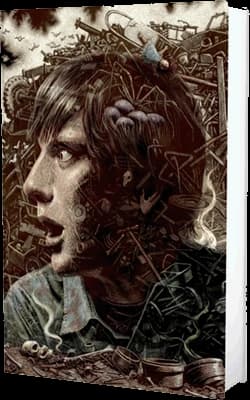
About this Edition
Dinner at an old tavern, a walk in the woods, a beach vacation, an invitation to a party from a long-lost friend. In a Terry Lamsley story, any harmless diversion can be a catalyst for waking nightmares. Lamsley guides his characters through the veil of normality and into terrifying mystery. Criteria for survival includes the following: do not make friends with the new neighbors; avoid mysterious shapes seen in fields; stay away from stones with strange markings. It is never a good idea to take a ferry to a strange island or pull off the road to visit a small village, as the characters in “Made Ready,” “Blade and Bone,” and “Lost Boy Found” discover. In these stories, the real and unreal, the seen and unseen, are tied to the past and present, to the physical and mental. These components crash into and through each other, unleashing the supernatural, the bizarre, and, for the people at the center of the tales, horrific outcomes.
The fates of these characters are determined by outside circumstances as well as their own personal histories and attitudes. Sometimes they are preoccupied by vanity and personal desire, failing to recognize mortal danger; sometimes they are simply naive. Philanderers, snobs, the close-minded, or anyone who has recently inherited anything will face peril, as will the reckless and the overly timid. The natural landscape is not to be trusted, and weather is often unfriendly, placing many of these stories within the realm of folk horror. Land and sea are complicit in constructing the mental and physical mazes of fright found in “Back in the Dunes,” “The Walls,” and “The Stunted House.”
These are people estranged from the land and from each other. The impetus for ancient dark magic to pierce through the screen of reality almost always begins with an inability to cope with the minor irritations of daily life. Small inconveniences develop into elaborate tableaux of horror. The awkward uneasiness of socializing or conversation at the beginning of a story (as in “Someone To Dump On” or “An Evening With Harrod”) mirrors the shifting uncertainty of sanity. For Lamsley, a lack of communication between humans, from garbled phone connections to petty rudeness, mirrors the broken connections between this dimension and the next. Once the interdimensional connection is established, certain doom awaits.
In an industrialized technocracy where everything is supposed to be explainable, occult mysteries are often ignored. It is not until the spirits, monsters, or curses are already upon them that these people accept the presence of the unknown. In “Under The Crust,” a man is inexplicably drawn to a garbage dump where refuse, cast-off appliances, and the ephemera of disposable society act as a breeding ground for a kingdom of garbage creatures. “Suburban Blight” features a peculiar type of flower flourishing among the abandoned relics of an unused Olympic sports complex, thriving on the recklessness of urban development and the ignorance of the city’s residents.
Many of these tales are centered around Lamsley’s hometown of Buxton, England. Though set in the 1990s to early 2000s, the past is never far behind. Medieval flashbacks creep through the narrative, and at times the settings are evocative of the uncanny weirdness found in 1970s British television shows like *Journey To the Unknown*, *Dead of Night*, or *Children of the Stones*. Anyone who has experienced bureaucracy in modern medical institutions will recognize the nightmare logic found at the hospital/prison of “Sick House Hospitality,” while childhood trauma haunts “Inheritance,” “The Break,” and “Running In The Family.”
There are passages containing dark humor, as in “Suburban Blight” when protagonist Hal Hollins wonders at being “discountenanced by a mere vegetable.” There is more than meets the eye to social worker Sylvia, who is sent to check on a new client in “Volunteers,” and elderly Conrad in “R.I.P.” engages in a last-ditch effort at rescuing a misguided friend from an ominous blanket of fog.
Publication Details
Format
hardcoverEdition
LimitedPublished
2025-12
Ships
2025-12-31
ISBN
9781613473627
Print Run
500 copies
Retailer
Centipede PressProducer
Centipede PressPhysical Features
Contributors
Compare Editions

Comments
…